

Script
1 scene · 0:28
Scene 1
0:28
SCENE CONTEXT
A 28-second short film in seven cuts, the second part of the story. The knight kneels on one knee behind his big shield in the mud outside the shut gate of the mountain fortress while the enemy army's volley hammers into it through drifting fog. He throws the shield away, draws his longsword and charges the army up the slope. Seen from the front, running straight at the camera, two arrows hit him, the shoulder and then the thigh; he goes down onto one knee, drives the sword into the mud, lets go of it and, as time slows, opens his arms wide to the sides: he knows what is coming and offers himself to it. From the front, with his arms open, the sky begins to flash over him, and the first flash snaps time back to real speed. From behind him, ten metres back, his arms still open, lightning comes down on the army: three bolts into three different places in it, men dropping dead at each one, the blocks breaking and running, and heavy rain with it. His arms come down and he only watches. His eyes, through the slit, close. From far away, alone in the empty field, kneeling with his head bowed onto the hilt of his sword, the whole fortress and the mountains above it behind him under a vast black sky, a last bolt comes down the full height of the frame into the tower above the gate that was shut on him: stone bursts and the top of the tower burns in the rain. The picture holds on him to the last frame.

CAST AND REFERENCES
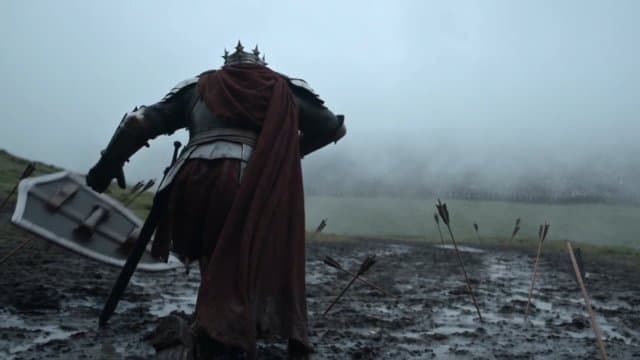
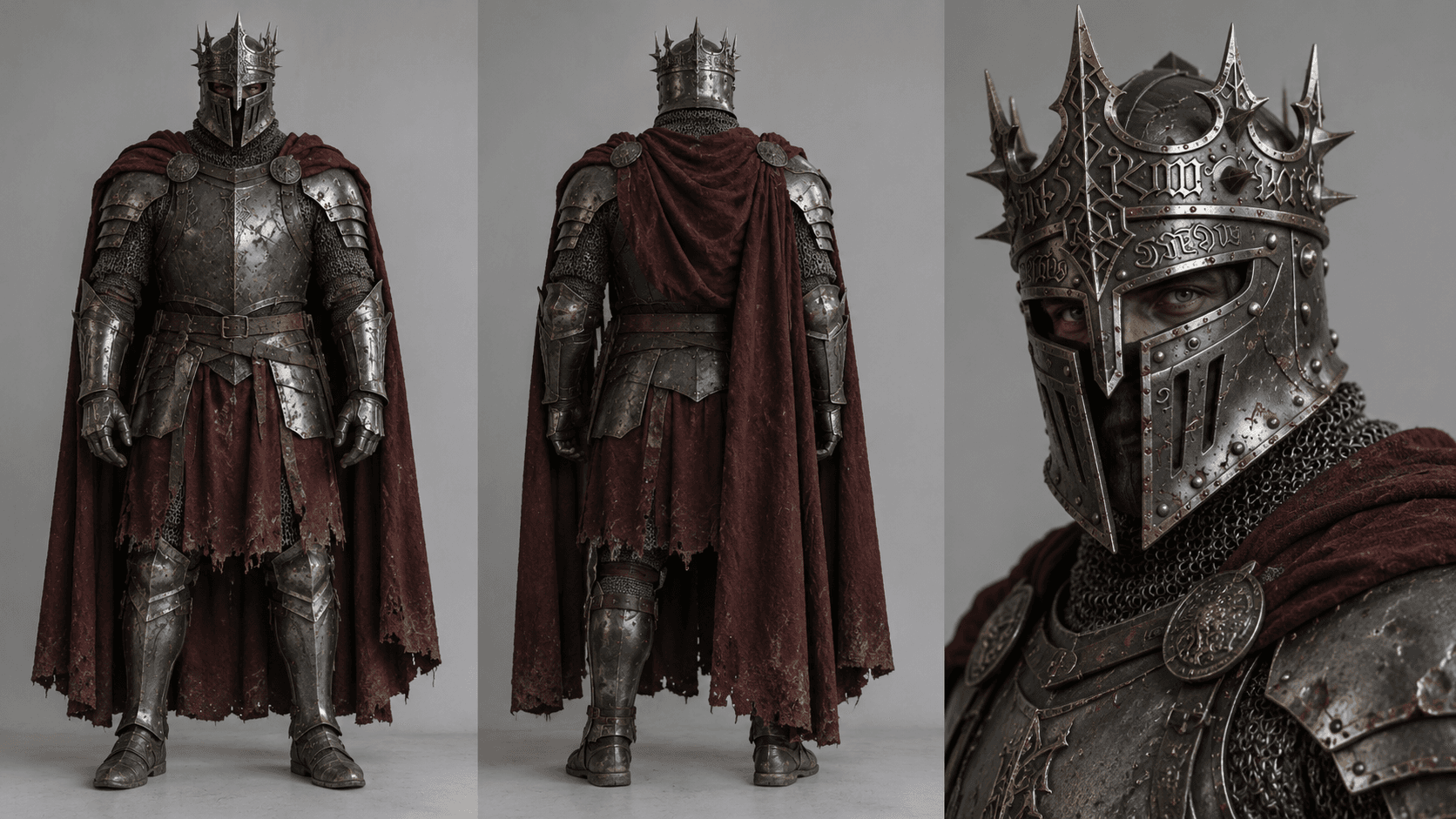
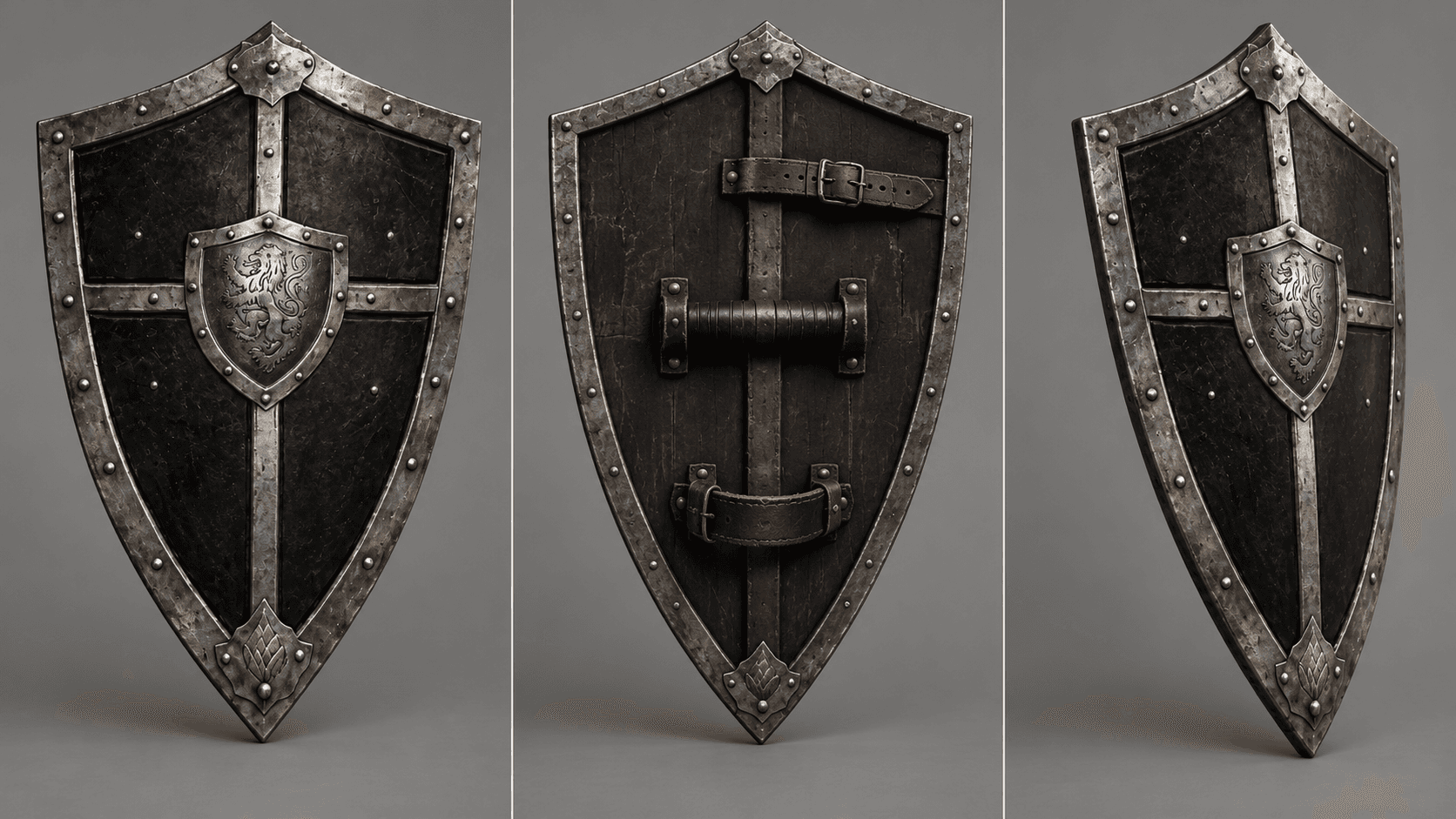
@knighteyes is the knight, visor closed in every cut, his eyes visible through the wide eye opening, a longsword at his hip. @shield is his shield, on his left arm at the start; it matches its reference exactly in shape, size and design and is never carried again after it lands in the mud. @knight_shield_throw_run_ref is the knight himself in a shot from the first film, filmed from behind him and slightly to his right, handheld, low: on one knee behind the shield he rises, throws the shield away to his left, draws the longsword from his hip in one wide arc over his head and runs up the slope toward the army. CUT 2 is a new shot filmed from scratch that echoes @knight_shield_throw_run_ref: its camera, its action and its speed. The clip itself is never edited, re-cut, extended or restyled. The enemy army has no reference: hundreds of soldiers in dark mail and grey-brown cloth standing in dense blocks across the far side of the field, pale banners on tall poles among them; the archers are the front ranks of these blocks. One archer is seen close in CUT 1; the rest are grey figures in the fog, seen only as they fall and run, and not at all in CUT 6 and CUT 7. No one else appears. The traitor is not seen.

LOCATION MAP
The same ground as the first film, as it was photographed there. A grey stone mountain fortress at blue hour. Its gate wall is a tall flat wall of grey ashlar stone with one tall rectangular gate opening in it, and that opening is SHUT: a heavy iron grid is lowered all the way to the ground inside it, square iron bars from the lintel to the mud, a dark wall of iron with no gap beneath it and nothing visible through it but darkness; no one passes through it, nothing moves in it, and it stays shut like this in every frame of the film. Over the gatehouse stands a square stone tower with a crenellated top: the tower the last bolt strikes. Behind and above the fortress, mountain slopes rise and fade ridge after ridge into grey-blue fog under a low, black cloud ceiling. In front of the shut gate lies a wide band of black trampled mud with standing puddles, stuck with dozens of arrows standing at steep angles; grass verges on either side of it. At the start of the film the knight kneels on this mud band about 10 m in front of the shut iron grid, facing the army, the gate wall filling the ground behind him. From the gate the mud runs away from the fortress as a trampled track up a gentle slope, a grass hillside rising on the knight's left as he runs, grass falling away on his right. Beyond the slope a wide flat grass field lies in the fog, and across it, about 100 m from the gate, the enemy army stands in dense dark blocks that span the whole width of the valley, pale banners on poles rising out of them, the archers in the front ranks; the blocks fade back into the fog so their depth cannot be seen. Low fog drifts across the slope and the field, knee-deep in places, and the arrows cut through it. In every shot from the army's side the gate wall and the tower stand behind the knight.

FIRST FRAME / BLOCKING
16:9. Medium close-up, about 85 mm, of an enemy archer's face in three-quarter profile at full draw, the fletching of the arrow at his cheek, fog behind him, the dark mass of the front rank soft beside him. Already moving: his fingers opening on the string. Sound first: at 0:00.3 the string snaps and the arrow leaves.

FORMAT MODE
CUT 1 (about 2.5 s). From the army's side, flying toward the fortress. The archer releases at 0:00.3 and the camera leaves with the arrow: it flies right behind the shaft, close, fixed to it, and this one arrow stays in the frame for the whole flight, its grey fletching sharp in the lower foreground from the first metre to the last, the field and the slope rushing beneath through low drifting fog, dozens of other arrows flying alongside and above it. Ahead, the whole time, the fortress: the grey gate wall with the shut iron grid lowered to the ground and the tower above it is the backdrop of the entire flight, growing as the arrow closes, and in front of it, on the mud, the knight, small and growing fast, on one knee behind @shield about 10 m in front of the shut grid, the shield coming up a fraction to meet the volley. At about 2.5 s the camera stops a metre short of the shield and the arrow we have followed flies on out of the foreground and slams into the exact centre of the shield, and stays there, its shaft standing out of the shield and quivering, in full view, the same arrow, never vanishing; within the same half second four more arrows strike the shield around it and stay in it; the rest of the volley flies past him, some arrows into the mud around him, some rattling off the gate wall and the iron grid behind him. The frame jolts to a stop on the impact.

CUT 2 (about 5.5 s, cut on the impact). The shot of @knight_shield_throw_run_ref: handheld tracking camera from behind him and slightly to his right, low, about 35 mm. As in @knight_shield_throw_run_ref: he rises off the knee, swings the shield off his left arm and throws it away to his left, where it lands face down in the mud with the five arrows in it; his right hand crosses to his hip and the longsword comes out of the scabbard in one wide arc over his head; and he runs, flat out, up the track toward the army, the camera running behind him; ahead, across the field, the dark blocks of the army in the fog, the banners above them, growing; low fog drifting across the slope. The army's arrows come down ahead of him and to his sides and stick into the slope there; none of them come near the camera and none of them touch his back, which stays bare steel. No arrow hits him in this cut. The cut comes mid-stride, at full speed.

CUT 3 (about 5 s, cut on his stride). From the front, on the army's side, handheld, low, about 35 mm, about 4 m from him, the same stride continuing, the fortress with its shut iron grid and the tower behind him: he runs straight at the camera, and the camera backs away ahead of him up the track at his speed, keeping him in frame from the front, his visor toward the lens, mud spraying, low fog drifting across the slope. The army's arrows come in from behind the camera, pass him on both sides and stick into the slope behind and around him; none of them touch his back. At about 9.5 s one arrow hits the front of his left shoulder and stays standing in the shoulder plate, seen clearly from the front: the blow turns him a quarter turn and he stumbles, and keeps coming. At about 11.5 s a second arrow hits the front of his right thigh and stays standing in it: the leg folds under him, he goes down onto his right knee and drives the sword point into the mud in front of him, and the camera stops with him, about 4 m in front of him, low. Then he lets go of the hilt, the sword standing in the mud, and as his hands leave it everything slows into slow motion, about a quarter of real speed, like a high-speed camera: both arms begin to rise slowly and open to the sides, palms open, his head coming up toward the army, the last arrows of the volley drifting down into the mud around him, drops of mud hanging in the air. Exactly two arrows are in him, both in his front; there is no third anywhere on him. The cut comes with his arms halfway open, still rising.

CUT 4 (about 2.5 s, still in slow motion). From the front, medium close-up, about 50 mm, low, at the height of his chest, the gate wall with its shut iron grid and the tower soft in the fog behind him: his arms finishing their slow opening and holding there, wide, the sword standing in the mud in front of him, the two arrows standing in him, one in the front of his left shoulder, one in the front of his right thigh, no others, his visor toward the army, his eyes in the slit steady, his breath slow. He waits for the volley. Then the sky breaks: at about 14 s a hard white-blue flash lights his whole front and the mud from above and in front, with a crack of thunder at the same instant, and with that flash time snaps back to real speed, hard; at about 15 s a second flash, brighter, the fog around him glowing: something is happening beyond the camera that we do not see. His eyes in the slit flick up. His arms stay open.

CUT 5 (about 7 s, real speed). From behind him, about 10 m back, at the height of a standing man, locked, about 35 mm: his kneeling back and his open arms in the lower middle of the frame, the sword standing in the mud beside him, and beyond him the whole army filling the far side of the valley in the fog under a black sky, its banners above the blocks. At about 16.5 s a forked bolt comes straight down into the left block of the army: the frame goes white for an instant with a crack of thunder at the same moment; the men around the strike drop dead where they stand, dozens of them, as if struck through. With this first bolt heavy rain comes down, sheets of it crossing the field. At about 18.5 s a second bolt into the centre of the army, where the banners are thickest: more men down, the banners tilting and going down one after another; the men beside them turn and run, away to the sides and back into the fog, and the breaking spreads backward through the blocks in waves. After this second bolt his open arms come down, slowly, to his sides, and he kneels and simply watches. At about 20.5 s a third bolt into the right block as it is already running: it drops the men nearest it and the rest scatter into the fog. No one runs toward the knight: the ground between him and the army stays empty, and the field in front of him empties block by block until the last running figures vanish into the fog and only the fallen, the smoke and the rain are left.

CUT 6 (about 1.5 s). Extreme close-up of his eyes through the wide eye opening of the helmet, macro feel, the eyes razor sharp, the steel edges soft, rain running over the steel and the skin, the flashes fading in the wet. His eyes follow the last of the army into the fog. Then they close, slowly.

CUT 7 (about 4 s). Very wide and high, from the army's side, about 40 m from him and well above the ground, locked, about 28 mm, in pouring rain, composed for the sky: the knight small at the bottom centre of the frame, alone in the middle of the empty field, kneeling, both hands on the hilt of the sword standing in the mud and his head bowed down onto his hands; behind him across the slope the whole fortress in the lower third of the frame, the gate wall, the iron grid shut down to the ground and the tower above it; above the fortress the mountains rising ridge behind ridge into the fog; and above them, filling the whole upper half of the frame, the black storm cloud, rain falling out of it in sheets. No one else is anywhere in the frame; the field is empty. At about 26 s the last bolt comes down out of the top of the frame, the full height of the picture, a forked bolt from the cloud through the rain onto the top of the tower, the whole fortress, the mountains and the knight in frame at the moment it hits: the flash lights the whole valley and his bowed back white, the crack, stone bursting from the crenellations, masonry falling down the wall beside the shut gate, fire taking hold in the top of the tower even in the rain, smoke torn sideways by the wind; the gate itself does not open and does not move. Over the last seconds a burning piece of the tower top breaks away and falls down the wall, and the fire grows, lighting the rain orange under the black sky. He does not lift his head and does not turn round. The picture holds, the knight small at the bottom, his head on his sword, the burning tower behind him, the mountains and the storm above, until the very last frame. No fade, no black: the film ends on this frame.

PERFORMANCE
Real, heavy, unhurried where he is hurt and fast where he is not. The archer in CUT 1 is calm craft: no expression, no look at the camera. The knight rises and throws the shield as a decision, with no pause, and in CUT 3 runs at the camera without ever looking into the lens: his eyes are on the army beyond it. Hit in the shoulder, he is turned and stumbles and keeps coming; hit in the thigh, the leg simply folds. Opening his arms is not a gesture to the camera and not a scream: it is slow, deliberate, exhausted, the arms coming up and out and staying there, the head up, the breathing hard inside the helmet; a man who has decided to die standing his ground. He does not flinch at the flashes; only his eyes move. When the bolts come down on the army he does nothing: after the second his arms lower slowly to his sides and he kneels and watches, still, like a man watching something he does not understand. In CUT 6 the eyes close slowly, not in sleep, in release. In CUT 7 his head rests on his hands on the hilt and he does not move when the tower is struck. No roar, no raised sword, no look back at the tower, no looking into the lens. The army's panic is staggered and never synchronised: at each bolt those around it fall dead, the men beside them run first, and the breaking spreads back through the blocks in waves, never the whole army turning at once, and never toward the knight.

PHYSICS
Real wooden arrows with grey fletching, always from the front, from the army; the camera flight in CUT 1 is at arrow speed, the ground blurring beneath; the followed arrow is one physical arrow that stays in frame from the bowstring to the shield and stands in the centre of the shield after it hits; four more strike the shield around it; the impacts jolt the shield. Low fog drifts across the slope and the field and the arrows cut it. The shield lands face down in the mud with the arrows in it and stays there. The sword is drawn in one arc; driven into the mud it stands upright on its own and stays there to the last frame. Exactly two arrows hit him and stay standing in the front of his armour, one in the left shoulder plate and one in the right thigh, from the moment they hit until the last frame; no other arrow ever touches him, nothing ever stands in his back, and the count never grows. Slow motion begins the moment his hands leave the hilt at about 12.5 s and ends with the first flash at about 14 s; in it the arrows, the mud and his arms move at about a quarter of real speed; everything before and after is real speed. The iron grid of the gate is a heavy fixed thing: it never rises, never opens, never moves. The flashes in CUT 4 are light only, no bolt in frame. Each strike in CUT 5 and CUT 7 is a real forked cloud-to-ground bolt, a single instantaneous flash with the crack of thunder at the same instant, the whole frame overexposed for a few frames, then an afterimage; the bolts into the army throw men and bows down dead and leave smoking ground; the bolt into the tower shatters stone, pieces falling down the wall, and fire catches in the top of the tower. Rain begins with the first bolt into the army at about 16.5 s and pours to the end: sheets across the field, drops bouncing on the armour, the mud going to water, the fire in the tower smoking hard in it. Banners fall as the men holding them run. The wind rises through the film, in the grass, in the banners and in the cloak.

LIGHTING
Blue hour, after sunset, no sun. The cloud ceiling low and black over the field. Soft cold light from the open sky; a steel-blue sheen on the armour, deep shadow in the joints. Each flash and each bolt lights the whole slope and the field from above with a hard white-blue flash for a few frames, the fog and the rain glowing, then the cold dusk returns. After the last strike the fire in the top of the tower is the only warm light in the film: orange on the wet stone, on the rain and on the back of the knight's armour. No light comes through the gate: behind the iron grid there is only darkness. No golden light, no flare, no glow particles.

AUDIO
At 0:00.3 the string snaps; then the hiss of the arrow and the rush of air, other arrows hissing alongside; at about 2.5 s the heavy thud into the centre of the shield and four more thuds right after it, arrows rattling off the stone and the iron behind. CUT 2: his hard breathing inside the helmet, the shield thrown down into the mud, the long ring of the sword drawn, running steps, arrows thudding into the slope ahead. CUT 3: the same breathing and steps now coming at the camera, arrows hissing past the lens; at about 9.5 s a hard knock into the shoulder plate and his grunt; at about 11.5 s the second hit, his knee splashing into the mud, the sword point driven into the ground; as his hands leave the hilt and the slow motion begins, all sound goes dull and distant, as if under water, the arrows landing around him as soft far thuds, only his slow breathing clear. CUT 4: the same underwater quiet, his slow breath, far behind the camera the long creak of hundreds of bows drawing; at about 14 s the first crack of thunder with the flash brings full sound back at once, loud and sharp; at about 15 s a louder crack, rolling over the valley. CUT 5: at each bolt a deafening crack at the same instant as the flash, then rolling thunder; screams, bows dropping, the rising roar of thousands of men running, fading back into the fog; the rain arriving with the first bolt as a wall of sound and staying. CUT 6: rain on steel; his breath, slowing. CUT 7: the rain and the wind over the whole valley, nothing else alive; at about 26 s the last crack, enormous, rolling off the mountains, stone falling, the roar of fire, a burning beam going down the wall; the rain and the fire continue to the last frame. No music. No spoken words.

STYLE
A frame from a modern prestige drama series, photographed on location on 35 mm film through vintage spherical lenses. Cold, restrained grade: slate blue, grey-green and charcoal, low saturation everywhere; the lightning and the fire in the tower are the only bright accents. Deep true blacks, soft highlights that never clip, fine grain. Depth comes from layered fog fading to grey-blue and from the rain. Real-world imperfection: mud, wet stone, worn cloth, breath in the cold air, water on the lens in the rain. Camera held still wherever the action is still: the only handheld shots are the two running cuts. The storm as in a nature documentary, real, not drawn. Not CGI, not a video-game cinematic, not a fantasy wallpaper: no golden glow, no orange sky, no sun in frame, no bloom, no oversaturation, no AI gloss.

POSITIVE LOCKS
- @knighteyes and @shield match their references 100%. Sheet backgrounds and layouts NOT inherited; @shield controls only the shield.
- @knight_shield_throw_run_ref: CUT 2 echoes its camera, action and speed. New shot filmed from scratch; never edit, re-cut, extend or restyle the clip itself.
- In CUT 1 the followed arrow never leaves the frame and never disappears: it is the one arrow that stands in the exact centre of the shield after the impact, with four more around it.
- The gate is SHUT in every frame: the iron grid lowered all the way to the ground, no gap beneath it, only darkness behind it; it never opens and never moves, not even when the tower is struck.
- Exactly two arrows hit him and stay in him, both in CUT 3, the front of his left shoulder and the front of his right thigh; never a third, and nothing ever stands in his back. No arrow hits him in CUT 2.
- He goes down onto his right knee once, at about 11.5 s, and never stands again; the sword stands in the mud in front of him from then to the last frame.
- Slow motion only from the moment his hands leave the hilt at about 12.5 s to the first flash at about 14 s; real speed everywhere else. CUT 3 and CUT 4 are both from the front and the arms keep opening across the cut without a jump.
- Lightning: two flashes with no bolt in frame in CUT 4; three bolts into the army in CUT 5, into three different places; one bolt into the top of the tower in CUT 7, seen full height from the cloud. Nothing else, and lightning never touches the knight. No rain before the first bolt into the army; heavy rain from then to the end.
- No soldier ever runs toward the knight or comes near him. In CUT 6 and CUT 7 no one but the knight is in the frame.
- CUT 7 shows the whole fortress, the mountains above it and the storm sky filling the upper half of the frame, the knight small at the bottom centre.
- The film ends on the picture: no cut to black, no fade, no black frame anywhere.
- The visor is closed in every cut; only his eyes show through the wide eye opening; never a raised visor. The sword always points away from the camera or into the ground. No blood, no visible wounds, no gore. Nobody speaks. Nobody looks into the lens. No text anywhere.
Cast
knight-shield-throw-run-ref
Clip
knighteyes
Character
shield
Prop
Settings
16:9480plive-action
AI-generated video, published by the studio owner. Report this page