

Script
1 scene · 0:14
Scene 1
0:14
A 14-second short film in two cuts. The hour before sunrise, a torrential downpour, the last second of a battle and what comes after. A wide flat battlefield in trampled wet grass and mud, fallen knights lying in it in every direction and heaped thickest where the last two men stand, the far field lost in a wall of rain, grey mountains beyond. One knight pulls his sword out of the last man standing against him with one hard pull and lets him fall. He is the only one left on his feet. He turns and walks away through the dead, spent, three full steps, the camera moving slowly round him as he walks and arriving behind him just as his legs give on the fourth step: he falls onto his side in the mud among the fallen, rolls onto his back and pulls the sword up to his chest, both arms wrapped around it, holding it the way a man holds something he will not let go of. The camera pulls away from him straight upward through the pouring rain until he is one small figure among hundreds of the fallen. No one speaks.

CAST AND REFERENCES
@knighteyes is the knight. His helmet is closed in every cut, exactly as on his sheet, from the first frame to the last. In this film he is drenched, rain pouring off the armour in streams, mud and dark blood on the steel being washed into streaks, and he holds a longsword in his right hand from the first frame until he pulls it to his chest. He has no shield. The last enemy has no reference: a knight in mud-covered plate and mail, seen only in CUT 1, only from behind and only from ten metres, his face never shown. The fallen have no reference: men in plate and mail lying still in the grass and mud, faces turned away or hidden, never moving, rain bouncing off them. No horses, living or dead.

LOCATION MAP
A wide flat battlefield at the hour before sunrise under a torrential downpour and a low ceiling of black-grey cloud. The rain is a wall: the air is grey with water, the far field is lost at a hundred metres, and every surface throws up spray where the drops hit. Knee-high wet grass trampled flat in long swathes, churned to mud where the fighting was thickest, standing water in every hollow boiling with rain, and in it the fallen, lying where they fell: hundreds out toward the rain in every direction, and thickest right where the last two men stand and along the few steps he walks, bodies within a metre of him on every side, lying two deep in places, among broken lances standing crooked, dropped shields and a torn standard on a leaning pole. Ahead of him, in the direction he walks, the field is the same all the way to the rain: more of the fallen, more lances, more water, and nothing else; nobody is there. Three steps from where the enemy falls, at least three metres from the enemy's body, there is one gap in the heap just the size of a man, and that is where he goes down. Far off on one side, grey mountains, barely there through the rain, their tops lost in the cloud.

FIRST FRAME / BLOCKING
4:3. Wide, smooth and steady, about 35 mm, at chest height, ten metres directly behind the last enemy. The enemy's back fills the left of centre, already folding; past him, face-on to the camera, @knighteyes with both hands on the grip of his sword, the blade in the enemy's body and hidden by it, his arms already in the pull. Rain falls in dense heavy sheets between the camera and the men, thick visible streaks filling the whole frame, bouncing off both suits of armour in spray; a few drops hit the lens and run down it. Around and behind them the fallen lie close in the mud, and beyond them the field disappears into grey rain. Already in motion on frame one.

FORMAT MODE
CUT 1 (about 7 s), one continuous steady shot. The pull is one hard fast wrench and it is over in the first half second: at 0:00.3 the sound of steel dragged out of mail under the roar of the downpour, the blade comes clear above the enemy's shoulder, and the enemy's breath goes out of him. He never stands holding the sword in the enemy's body. By 0:01 the enemy has folded at the knees and fallen forward into the mud with a splash and does not move again. @knighteyes does not stand over him and does not fall: the moment the enemy is down he turns away to screen right and walks, the sword hanging from his right hand with the point dragging through the mud, chest heaving, rain pouring off his helmet and shoulders in streams and bursting into spray on the steel. As he walks, the camera moves slowly and smoothly round his right side on a wide arc, keeping about six metres from him and keeping him full height, head to boots, in the frame the whole way: on his first step it sees him from three quarters in front, on his second step side on, on his third step from three quarters behind, and it arrives directly behind him, a little above his shoulder, in the very moment his legs give. The arc takes the whole walk; it is never finished early. As the camera comes round, the frame fills with where he is going: the field ahead of him, the fallen lying close around his feet and heaped in the grass and the boiling standing water in every direction out to the wall of rain, the lances, the shields, the leaning standard, and nothing else there, nobody coming, only the dead and the rain. He walks like a man at the end of everything: heavy, uneven, stepping between the fallen, one shoulder lower than the other, the sword point drawing a line in the mud behind him. Three full steps, each about a second, from about 0:01 to about 0:04.5, carrying him at least three metres from the enemy's body. Then the fourth step never lands: his legs give, not from anything underfoot but because there is nothing left in them, and he falls sideways onto his right shoulder into the gap among the fallen with a splash, the sword still in his hand, and lies there on his side for a breath, a body lying within a metre of him on either side. The camera stops where he falls, behind him and a little above, looking down at him. Then he rolls slowly onto his back, pulls the sword up onto his chest with both hands, the hilt under his chin, the flat of the blade lying down the breastplate toward his feet, and wraps both arms over it, pressing it to his chest the way a man holds something he will not let go of. He lies in the lower centre of the frame among the fallen, the field of the dead going on past him into the rain, the rain hammering the armour and throwing up spray around him. His arms close over the sword.

CUT 2 (about 7 s), cut as his arms close over the sword. Directly overhead, the lens pointing straight down, about 28 mm, starting three metres above him. He fills the centre of the frame lying on his back in the mud, head toward the top of the frame, the sword pressed to his chest with both arms wrapped around it, the hilt under his chin, the blade lying down his body, and already at the edges of the frame the fallen lie beside him, an arm, a helmet, a shield, within a metre of him. Rain pours down past the lens onto him in thick streaks, bursts off the steel in spray, runs off the armour in streams into the mud, and the puddles around him boil with it. Through the eye opening his eyes are open to the sky. He does not move. The camera pulls away from him straight upward at a slow constant speed, no drift, no rotation, no tilt, keeping him dead centre, and he grows smaller in the frame without pause from the first frame of this cut to the last: at ten metres he is one of a dozen men lying in the mud around him; at twenty metres one of dozens, the bodies heaped close in every direction; at thirty-five metres one of hundreds, lying out to where the rain takes them, the broken lances and the standard among them, the whole field seen through falling water, and he is told apart from the dead only by the one straight line of the sword held to his chest. The last second and a half holds still at the top of the rise: nothing moves but the rain.

OPTICS
Vintage spherical lenses, about 35 mm in CUT 1 and about 28 mm in CUT 2. Deep focus throughout; he is sharp in every frame of the film, and so is the field ahead of him. Rain is sharp near him and thickens into a grey wall with distance. In CUT 1 rain drops sit on the lens and run down it.

CAMERA
CUT 1 one smooth steady move: still for the pull and the fall of the enemy, then one slow continuous arc round @knighteyes's right side at about six metres, from in front of him to directly behind him, spread evenly over his three steps so that it reaches his back exactly as his legs give, never earlier, holding him full height the whole way and rising a little toward the end, then a full stop where he falls, by the time his arms close over the sword. CUT 2 one vertical rise, lens straight down, from three metres to about thirty-five, constant speed, no rotation, ending in a full stop. After he is down he does not move. No handheld shake anywhere.

ACTION
The pull of the sword is one hard fast wrench with the whole upper body, over in half a second; there is no slow drawing out and no holding. The enemy's fall is a collapse, knees first, then forward and down into the mud, done by the first second. @knighteyes turns and walks at once, no pause over the body: three heavy uneven steps between the fallen, each about a second, the sword dragging, nothing underfoot catches him. The fourth step never lands: the legs simply give out and he falls sideways onto the right shoulder, no hands out to break it. A breath on his side. Then the roll onto the back, slow and heavy under the weight of drenched armour. The sword is pulled up the body with both hands until the hilt is under his chin, the flat of the blade against the breastplate, and both arms wrap over it and press it to his chest and stay there. From that moment he does not move except for the rise and fall of his chest.

PERFORMANCE
Spent. He looks at nothing: the mud in front of his boots while he walks, then the sky. The breathing is ragged and loud from the first frame, worse with each step, and slows only after he is on his back and keeps slowing to the end. The embrace of the sword is the only tenderness in the film: slow, both arms, the way a man holds a person. No tears, no shaking, no looking around at the field, no other gesture. The helmet stays closed and the face is never seen; through the eye opening the eyes are open, tired, then on the sky with the rain pouring into them.

PHYSICS
A torrential downpour in every frame: rain falls in dense straight sheets, thick enough to be the most visible thing in the frame, bursts into spray where it hits the armour, drums on the helmet, pours off the steel in streams, pocks and boils the puddles, spatters the mud. The armour is heavy and drenched; mud and dark blood on it are being washed off in streaks. The trampled grass is flooded and gives under his boots; the sword point cuts a furrow in the mud behind him; the mud takes the shape of his body when he falls and water pools against him. The enemy falls under his own weight in armour with a splash; so does he. The sword is heavy; held against the breastplate by both arms it does not slide, and rain runs down the blade. The fallen never move; cloth on them does not stir; rain bursts off them too.

LIGHTING
The hour before sunrise, heavy overcast, no sun, no moon, no fire, no lamp. One soft cold light from the whole sky, almost shadowless, dimmed by the rain. The wet steel catches thin lines of sky on every edge and glitters with running water, and from above every suit of armour, his and the fallen, reads as a pale wet shape on the dark mud. The standing water around them mirrors the pale sky and is the brightest thing in the field. The rain shows as dense grey streaks against the dark grass and as a solid grey wall over the far field. The mountains are flat grey shapes almost lost in the rain.

AUDIO
No music, no voice, no spoken word in the whole film. The downpour from the first frame to the last, a roar, rain on steel, on mud, on water, louder than everything else in the film. CUT 1 at 0:00.3: steel wrenched out of mail in one fast scrape under the roar, a short breath leaving the enemy, armour hitting the mud with a splash by 0:01; then his ragged breathing under the hammering of rain on his helmet, three heavy steps sucking in the mud about a second apart, the sword point scraping through it, the creak of armour; the fall, a body in armour hitting flooded ground with a splash; a breath; the slow roll, the scrape of the blade drawn up the breastplate and the small sound of the arms closing over it. CUT 2: rain hammering the helmet and the breastplate close and loud, his breathing slow and fading as the camera rises, the rain widening into the roar of a whole field under water; nothing else to the end.

STYLE
A frame from a modern prestige drama series, photographed on location at the hour before sunrise in a torrential downpour on 35 mm film through vintage spherical lenses. Cold, restrained grade: slate blue, grey-green and charcoal, low saturation everywhere; the only brightness is the pale sky in the standing water and on the wet steel. Deep true blacks, soft highlights that never clip, fine grain. Depth comes from the rain taking the field and the mountains by layers. Real-world imperfection: mud on steel, water streaming off metal, rain bursting into spray, drops on the lens, flooded grass. Not CGI, not a video-game cinematic, not a fantasy wallpaper: no teal-and-orange look, no glow, no bloom, no god rays, no AI gloss.

POSITIVE LOCKS
- @knighteyes matches his reference 100% in every cut. Sheet background and layout NOT inherited.
- The helmet is the same object in every cut, closed from the first frame to the last: never raised, never opened, never swapped for another helmet, never taken off. His mouth and his full face are never shown anywhere in the film; only his eyes through the eye opening.
- The only changes to the knight: drenched, rain pouring off the armour, mud and dark blood on the steel. No shield in any cut. No gore.
- A torrential downpour in every frame of the film, from the first to the last, never easing, never stopping: dense visible sheets of rain filling the frame, spray bursting off every suit of armour, water pouring off the helmet in streams, puddles boiling, the far field lost in grey rain. If the rain reads as a light drizzle or a few thin lines, it is wrong. No fog, no sun, no lightning.
- The blade is out of the enemy within the first half second of the film, in one fast pull; @knighteyes never stands holding the sword inside the enemy's body, not for a moment. The enemy is on the ground by 0:01.
- The last enemy appears only in CUT 1, only from behind, only at ten metres, his face never shown; the blade inside him is never visible, hidden by his body until it comes clear above his shoulder; he falls once, forward, and never moves again. After he falls there is only one living person in the film.
- @knighteyes stays on his feet and walks for at least three full seconds between the enemy's fall and his own: exactly three steps, carrying him at least three metres from the enemy's body, and he goes down on the fourth. He never falls at the moment of the pull and never falls beside the enemy. He never looks back at the body. He never trips, never stumbles over anything; the fall comes from his legs giving out.
- The sword is in @knighteyes's right hand from the first frame until he is on his back; it is never dropped, never planted in the ground, never thrown. From the moment he pulls it to his chest it stays there: hilt under his chin, the flat of the blade down the breastplate, both arms wrapped over it and pressing it to his chest, and it does not move for the rest of the film.
- He goes down once, in CUT 1, in this order: the legs give, the fall onto the right side, a breath, the roll onto the back. He never gets up, never kneels, never turns his head after he is on his back; only his chest moves with his breath.
- The fallen lie close around him in every frame of the film, within a metre of him on every side, heaped two deep in places, and visible at the edges of the frame from the first frame of CUT 2.
- In CUT 1 the camera moves round him in one slow even arc over his three steps, from in front of him to directly behind him, and is behind him only at the moment his legs give, never before; it shows him full height, head to boots, in every frame of the walk; it never circles past his back, never cuts, and stops where he falls. Ahead of him there is nothing but more of the fallen and the rain: nobody appears, nothing comes toward him. CUT 2 is one vertical rise from directly above, lens straight down, no rotation, no drift; he stays in the exact centre of the frame and grows smaller without pause from the first frame of CUT 2 to the last.
- The fallen lie still in every cut, never a face, never a movement. No horses. No birds.
- Real speed throughout, no slow motion. No title, no fade in, no fade out. No music. No text anywhere.
- In CUT 1 nobody looks into the lens. In CUT 2 he looks straight up at the sky, which is where the camera is; that is intended.
Cast
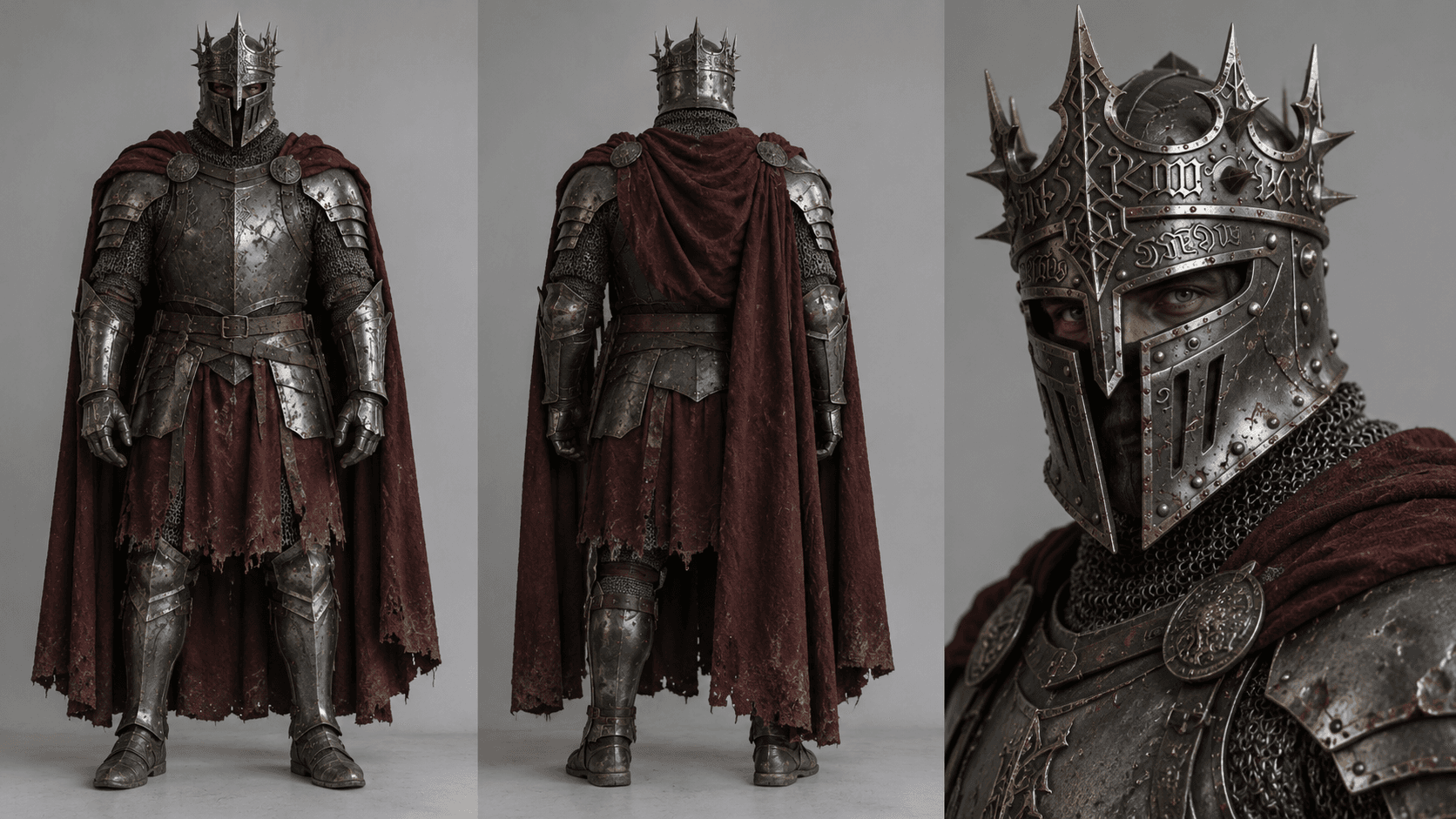
knighteyes
Character
Settings
16:9480plive-action
AI-generated video, published by the studio owner. Report this page